 | Dr. Ronald Widen
Dental Education
We emphasize the Guest Education aspect of our practice. We try to leave no stone unturned in explaining why we need to do the recommended treatment. We feel it is necessary for you, the guest, to be able to make an informed decision and together bring your mouth and self to optimum function.
Below as just some of the questions that we have been asked and feel necessary covering and will include more as time passes. Feel free to visit the ADA website for more imformation.
Frequently Asked Questions ( FAQs )
Click on the Links below to get a full description of each FAQ.
What is Root Canal Therapy ?RCT is a method of saving a tooth by cleaning out a damaged nerve and filling in the resulting chamber.
What is Gum (Periodontal) Disease ?Periodontal disease is the deterioration of the supporting structures of the teeth.
What are Dental Implants ?Dental implants are titanium screws or cages that are surgically placed in the bone of the mouth to which a tooth, bridge, or denture can attach to make a stable restoration.
Why should I Replace a Missing Tooth ?The empty space in your mouth starts to cause many problems including decay and periodontal disease, an unbalanced bite, and stress on the remaining teeth.
Why do I need a Crown (Cap)?A crown is needed on a tooth when the tooth is weakened by either decay, a fracture or a very large restoration.
I don’t like my Smile is there anything I can do?Besides Braces, there are three common procedures available; bonding, bleaching, and veneering.
Why does the Floss shred and get caught in my teeth?Floss can shred if the contact between the teeth is tight or there is a rough or broken surface between the teeth.
How can I avoid getting Cavities?The best way to avoid cavities is by eating right, brushing with a fluoridated toothpaste, flossing daily and visiting your dentist every six months. Children and some adults can benefit by having Sealants placed.
At what age should I start taking my Child to the dentist?At 1 year of age or when the first tooth develops.
What should I do if my Child’s Tooth is Knocked Out?Place the tooth in cool milk or if the child is old enough, under the child’s tongue. Be real careful not to swallow the tooth and get to the dentist within 30 minutes so it can be reimplanted.
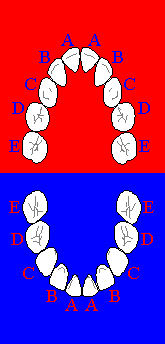
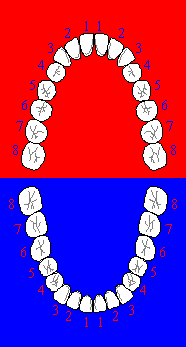
When do those Baby and Permanent teeth erupt?Teeth erupt at different times in all individuals . Your child’s tooth should erupt eventually unless your dentist tells you that there is no replacement permanent tooth.
Upper
A – Central Incisors 8-13 months
B – Lateral Incisors 8-13 months
C – Canines(cuspids) 16-23 months
D – First Molars 13-19 months
E – Second Molars 25-33 months
Upper
1 – Central Incisors 7-8 years
2 – Lateral Incisors 8-9 years
3 – Canines (Cuspids) 11-12 years
4 – 1st Premolars (Bicuspids) 10-11 years
5 – 2nd Premolars (Bicuspids) 10-12 years
6 – First Molars 6-7 years
7 – Second Molars 12-13 years
8 – Third Molars 17-21 years
Child Dental Care
Q. When should my child first see a dentist?
A: “First visit by first birthday” sums it up. Your child should visit a pediatric dentist when the first tooth comes in, usually between six and twelve months of age. Early examination and preventive care will protect your child’s smile now and in the future.
Q. Why so early? What dental problems could a baby have?
A: The most important reason is to begin a thorough prevention program. Dental problems can begin early. A big concern is Early Childhood Caries (also know as baby bottle tooth decay or nursing caries). Your child risks severe decay from using a bottle during naps or at night or when they nurse continuously from the breast.
The earlier the dental visit, the better the chance of preventing dental problems. Children with healthy teeth chew food easily, learn to speak clearly, and smile with confidence. Start your child now on a lifetime of good dental habits.
Q. How can I prevent tooth decay from a bottle or nursing?
A: Encourage your child to drink from a cup as they approach their first birthday. Children should not fall asleep with a bottle. At-will nighttime breast-feeding should be avoided after the first primary (baby) teeth begins to erupt. Drinking juice from a bottle should be avoided. When juice is offered, it should be in a cup.
Q. When should bottle-feeding be stopped?
A: Children should be weaned from the bottle at 12-14 months of age.
Q. Should I worry about thumb and finger sucking?
A: Thumb sucking is perfectly normal for infants; most stop by age 2. If your child does not, discourage it after age 4. Prolonged thumb sucking can create crowded, crooked teeth, or bite problems. Your pediatric dentist will be glad to suggest ways to address a prolonged thumb sucking habit.
Q. When should I start cleaning my baby’s teeth?
A: The sooner the better! With the eruption of the first teeth,clean your child’s gum with a soft infant toothbrush. For children under 2 years old, use only a smear of fluoridated toothpaste. For children over 2, a pea-sized amount of fluoridated toothpaste should be used. Remember that most children under 7 years of age do not have the dexterity to brush their teeth effectively, so work with your child to teach good brushing habits.
Avulsed or knocked-out tooth
If a tooth gets knocked out try to find the tooth! This may not be as easy as you think if the injury took place on a playground, basketball court or while skateboarding, so try to stay calm. Hold the tooth by the crown and rinse the root in water if the tooth is dirty. Don’t scrub it or remove any attached tissue fragments. If it’s possible, gently insert and hold the tooth in its socket while you head to the dentist. If that’s not possible, put the tooth in a cup of milk and bring it to the dentist. If milk is not available place the tooth under the tongue until a dentist can be seen, but don’t go to sleep with it under your tongue. Time is critical for successful reimplantation, so try to get to your dentist immediately.
Improve My Smile
The most popular methods for improving your smile are:
Braces
Bonding
Bleaching
Veneering
Braces
Braces are a common method of changing one’s appearance. 20% of today’s patients are adults. They are usually placed by an orthodontist or a experienced general dentist. Orthodontics is the dental field that involves the diagnosis, prevention and treatment of problems caused by poorly positioned teeth. When teeth are out of position they sometimes look unaesthetic but also are more susceptible to periodontal (gum) disease and dental decay. A poor bite can also stress your jaw joints (TMJs) and muscles and cause pain.
There are different types of treatments to correct the position of teeth. There are fixed and removable appliances. These appliances gently move the teeth and bone until they are in a desirable position. The most common type of fixed appliance is ‘braces’. The braces consist of a bracket, made out of plastic, metal or ceramics, and an arch wire which connects them. The teeth are moved by adjusting the pressures on the teeth by the arch wire. Sometimes, springs or rubber bands are used to help. These braces are tightened periodically and some discomfort is felt at that time. In certain instances the brackets can be placed on the lingual or inside surface of the teeth so they are less visible or almost invisible thin trays can be used (Invisalign).
Call us today to see if this may benefit you!
The length of time it takes to move the teeth to the desired location varies from person to person. The average is from 18 months to 30 months for children and may be longer for adults. The time depends on the difficulty of the case, the amount of room available, the distance the teeth must travel, the cooperation of the patient and the bone and the age of the patient. In some adults braces can’t correct the problem and a jaw surgery is necessary. After the braces come off a removable retainer is used to keep the teeth from moving back to their original positions. This retainer must be used. Sometimes it is still used years after the braces come off. More info.
Bonding
Bonding is the term used when a dentist ‘bonds’ a tooth colored resin onto the tooth to repair a fractured, worn or chipped tooth, cover up a discoloration on a tooth, or close a small space or gap between two teeth. The dentist lightly prepares the tooth to receive the material and etches the surface so the material has more surface area to bond to. He coats the tooth with a bonding liquid and then shines a light on the tooth to set it. He then places the putty like material on the tooth and shapes it to the desires shape and then shines a light on the tooth again to harden the material. After it is set he trims and polishes the resin to a luster. This can be performed in one or more appointments depending on the number of teeth involved.
Bonding usually lasts from 3 to 5 years and before needing to be repaired. Because the material is a plastic resin it is not as strong as your natural teeth and can be chipped or broken, if not careful. The material is also porous and eventually will pick up stains. The bonded surface will wear and get duller in appearance after a while unless special toothpastes are used. Proper home care and professional cleanings will keep your restored teeth healthy. Bonding not only restores your tooth but also helps to improve your appearance and self-confidence. People are sometimes hesitant to smile because of the way their front teeth look, after bonding they can smile freely again. More info.
Bleaching
A popular method for treating moderately stained or discolored teeth is bleaching. These stains often can not be removed with regular professional cleanings. The most popular method of bleaching is the at-home method. There are a few good products out on the market that are dispensed by dentists. I do not suggest to use the off the shelf variety. They can cause more harm than good.
Now we can lighten your teeth 7-10 shades in about an hour. Come visit the office and learn how your teeth can be the whitest they can be. ZOOM!! bleaching takes about an hour and a half total chair time. Your mouth is prepared so as not to injure any other areas while bleaching. Three 20-minute sessions of bleaching are done and then your teeth are re fluoridated to remove any sensitivity that may occur. Everyone, so far, has been delighted with the results.
If you think you can’t handle the hour and a half there is always the 7-10 day method. First, the dentist makes a mold of your teeth and makes a custom mouth tray. The mouth tray will hold the bleaching material against the tooth surface without concentrating the agent on the gum tissue. If the material contacts the gum tissue to long the gum tissue can be irritated or even burned. The tray is worn 1/2 hour to 2 hours per day and a noticeable improvement usually takes place within 2 weeks. Some bleaching agents say you can wear them all night but your teeth may get very sensitive after doing this. You may continue using the product until you reach your desired whiteness. Sometimes you can not achieve the desired whiteness and will have to settle for something less. The dentist may have you come in periodically to check the progress and the reaction to the gum tissue, if any. After you have lightened your teeth, you may need to periodically (once every couple of months) bleach them for a session to keep the whiteness. More info.
Veneering
Veneers or Porcelain Laminate Veneers are the strongest way to repair a broken portion of your tooth. They are used to correct the same things as bonding does. They can cover up discoloration, repair a damaged tooth or change the shape or size of your teeth. They are much stronger than bonding. They will not pick up stain like bonding does. They will retain their luster, unlike bonding. They will usually last 4 or more years. This is a two appointment procedure. The first appointment is the preparation phase. A small amount of enamel is removed off the front of the tooth and an impression is made. The impression is sent to the lab and the lab makes a front of the tooth, much like a false fingernail, out of porcelain. The dentist tries in, bonds, trims and polishes the veneers at the next appointment. The seating is usually a time consuming appointment and can last for hours. But usually quite worth the wait. Compared to crowns, veneers are a more conservative method for restoring a moderately fractured tooth.
Veneering not only restores your teeth but also helps to improve your appearance and self-confidence. People are sometimes hesitant to smile because of the way their front teeth look, after veneering you can smile freely again. More info. See photos in the Smile Gallery.
Sealants
How does a sealant help prevent decay?
A sealant is a plastic material that is usually applied to the chewing surfaces of the back teeth—premolars and molars. This plastic resin bonds into the depressions and grooves (pits and fissures) of the chewing surfaces of back teeth. The sealant acts as a barrier, protecting enamel from plaque and acids. Thorough brushing and flossing help remove food particles and plaque from smooth surfaces of teeth. But toothbrush bristles cannot reach all the way into the depressions and grooves to extract food and plaque. Sealants protect these vulnerable areas by “sealing out” plaque and food.
Is sealant application a complicated procedure?
Sealants are easy for your dentist to apply, and it takes only a few minutes to seal each tooth. The teeth that will be sealed are cleaned. Then the chewing surfaces are roughened with an acid solution to help the sealant adhere to the tooth. The sealant is then ‘painted’ onto the tooth enamel, where it bonds directly to the tooth and hardens. Sometimes a special curing light is used to help the sealant harden.
As long as the sealant remains intact, the tooth surface will be protected from decay. Sealants hold up well under the force of normal chewing and usually last several years before a reapplication is needed. During your regular dental visits, your dentist will check the condition of the sealants and reapply them when necessary.
Sealants are just for kids, right?
The likelihood of developing pit and fissure decay begins early in life, so children and teenagers are obvious candidates. But adults can benefit from sealants as well.
Key ingredients in preventing tooth decay and maintaining a healthy mouth are twice-daily brushing with an ADA-accepted fluoride toothpaste; cleaning between the teeth daily with floss or interdental cleaners; eating a balanced diet and limiting snacks; and visiting your dentist regularly. Ask Dr. Widen about whether sealants can put extra power behind your prevention program.
Floss Shredding
Floss can get caught in your teeth for a variety of reasons.
1. The contact is just too tight. If this is the case your dentist can lighten up the contact for you with a minor procedure. Actually taking a sand paper or metal strip between the teeth and removing some filling material. You want a tight contact so you don’t get food caught, but you also want to be able to floss. There are special flosses on the market that can be helpful for tight contacts, ask your dentist.
2. The floss is getting caught on a rough, overextended or broken portion of an existing filling. If this is the case your dentist may suggest that the old filling be replaced with a new one. It may be the same type of filling or it may require the filling be a casting, such as a gold inlay or a crown. This is necessary because the portion that is catching your floss is also catching plaque and bacteria. This plaque can lead to gingivitis or perhaps gum disease if not treated. Once treated the floss should pass trough without shredding.
3. The floss is shredding because there is a sharp surface around an area of decay between your teeth. Your dentist can x-ray this area and determine the amount of destruction present. Then you and your dentist can determine the appropriate course of action. Whether it be a silver filling, a gold filling, or a crown the decay must be removed and a new restoration placed.
Cavities
Now more than ever, kids are faced with a large variety of food choices; from fresh produce to sugar-filled, processed convenience meals and snack foods. What and when children eat may affect not only their general health but also their oral health. Americans are consuming foods and drinks high in starches and sugar more often and in larger portions than ever before. It’s clear that “junk” foods and drinks gradually have replaced nutritious beverages and foods for many people.
For example, the average teenage boy in the U.S. consumes 81 gallons of soft drinks each year! Alarmingly, a steady diet of sugary foods and drinks can ruin teeth, especially among those who snack throughout the day. Common activities may contribute to the tendency toward tooth decay. These include “grazing” habitually on foods with minimal nutritional value, and frequently sipping on sugary drinks. When sugar is consumed over and over again in large, often hidden amounts, the harmful effect on teeth can be dramatic. Sugar on teeth provides food for bacteria, which produce acid. The acid in turn can eat away the enamel on teeth. Almost all foods have some type of sugar that cannot and should not be eliminated from our diets. Many of these foods contain important nutrients and add enjoyment to eating. But there is a risk for tooth decay from a diet high in sugars and starches. Starches can be found in everything from bread to pretzels to salad dressing, so read labels and plan carefully for a balanced, nutritious diet for you and your kids.
Follow these rules to reduce your children’s risk of tooth decay:
– Sugary foods and drinks should be consumed with meals. Saliva production increases during meals and helps neutralize acid production and rinse food particles from the mouth.
– Limit between-meal snacks. If kids crave a snack, offer them nutritious foods.
– If your kids chew gum, make it sugarless – Chewing sugarless gum after eating can increase saliva flow and help wash out food and decay-producing acid.
– Monitor beverage consumption – Instead of soft drinks all day, children should also choose water and low-fat milk.
– Help your children develop good brushing and flossing habits.
– Schedule regular dental visits. (Information from ADA website)
What is Root Canal Therapy?
A root canal treatment or therapy is needed when a tooth’s nerve and associated blood vessels are irreversibly damaged. They may be damaged by trauma, which may fracture a tooth or by having deep decay that has infected the nerve. The end result is the same, an infection that leads to an abscess at the base of the tooth. Usually there is a throbbing pain in the tooth especially noticeable when laying horizontal, ie. in bed at night. There also may be a swelling in your jaw and it may be painful to chew on. Your tooth can usually be saved at this time.
If the abscess remains too long the tooth dies and the bone around the tooth is destroyed. The tooth must be removed if this happens.
A dentist or endodontist (root canal specialist) can save a tooth by removing the diseased nerve tissue, cleansing and then filling the nerve chamber with a rubber like material. This procedure can be done in one to three or more visits depending on the condition of the nerve. If there is an abscess antibiotic therapy may be used as well as possibly draining the infected site.
What is Gum (Periodontal) Disease?
Gum (Periodontal) disease is an inflammation or infection of the supporting structures of the teeth, the bone and the surrounding gum tissue. It is caused by a sticky, colorless film that is constantly forming on your teeth. This film is called plaque. If this film is not cleaned off the teeth with proper brushing and flossing the bacteria in the plaque cause an inflammation of the gum tissue called gingivitis. The symptoms of gingivitis are red, swollen, tender, or bleeding gums. If you have any of these symptoms it would be wise to contact a dentist as soon as possible. If left untreated it progresses to periodontitis.
Periodontitis occurrs when the plaque starts to calcify and become calculus or tartar. This then migrates under the gum tissue causing pocketing around the teeth and starts to destroy the bone tissue. If left long enough the entire supporting structure is destroyed and the tooth or teeth are lost. Unfortunately, this disease is found in 3 out of 4 adults over 35. The symptoms of periodontitis are loose or shifting teeth, gum tissue separating from your teeth, longer appearing teeth, and/or pus or an unpleasant taste or odor coming from your mouth.
Gingivitis can be treated at home by properly brushing and flossing daily to remove the bacteria laden plaque. Periodontitis can’t be treated at home. The tartar that forms under your gums must be cleaned off by a dentist or hygienist. This procedure is called root planing and scaling. If caught early enough minimum damage of the supporting structures occur and there is a good prognosis to keep the teeth. If it is more advanced other therapies including gum surgery or bone regeneration may have to be performed.In the worst case the teeth may have to be pulled.
So, eating well balanced meals, avoiding snacking (especially sweets), regular brushing, flossing and regular check-ups should limit your risk of getting gum disease.
What is a Crown?
A crown is the part of the tooth that you can see above the gums. If a dentist tells you ‘Your tooth needs a crown’ he is telling you is that your natural crown has broken or has been weakened and therefore a laboratory made or CEREC (one-visit) made crown or cover will be needed to restore your tooth. It may have been weakened by a fracture or crack in the tooth, an overly large silver filling, or having root canal therapy. Most crowns we make are made of either solid porcelain, porcelain fused to metal or a metal ( gold alloy).
Repairing your tooth with a porcelain crown will usually take one appointment with CEREC.
At the appointment Dr. Widen will numb the area and prepare the tooth by removing 1.5-2 millimeters of the natural crown away until the weakened portion of the tooth is removed and solid tooth structure remains making sure there is sufficient space for a porcelain crown to fit over the tooth. This procedure requires a great deal of skill and precision to ensure a successful result. The porcelain crown must fit perfectly to prevent further decay and gum disease. This crown will also restore the patients bite, prevent shifting of the teeth and must look good. After the preparation is completed, an optical impression of the area is taken and sent to the computer to be designed. Dr. Widen will design the crown and send the information to the milling unit for fabrication. Then the crown is bonded or cemented to your natural tooth. Your new crown should look natural and feel comfortable in your mouth. It is vital that you take care of the crowned tooth. The margins are areas that are susceptible to decay and must be kept clean. If you take care of your crowns they can last 5 to 15 years or even longer.
Crowns are not used as frequently in cosmetic dentistry as they once were because of more conservative procedures like porcelain onlays, veneers, bonding, and bleaching. However, if your front teeth have been severely damaged by decay or have large fillings in them or perhaps they are rotated or crooked and require the extra strength that a crown could provide you may be a candidate for a crown. Dentists who have experience in cosmetic dentistry understand the benefits of using the most conservative treatment possible to achieve the desired results and can advise you of the benefits of each.