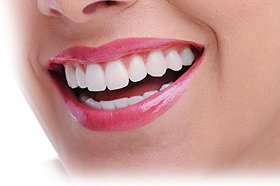
Improve My Smile
The most popular methods for improving your smile
are:
-
-
-
-
Braces
Braces are a common method of changing one's
appearance. 20% of today's patients are adults. They are
usually placed by an orthodontist or a experienced
general dentist. Orthodontics is the dental field that
involves the diagnosis, prevention and treatment of
problems caused by poorly positioned teeth. When teeth
are out of position they sometimes look unaesthetic but
also are more susceptible to periodontal (gum) disease
and dental decay. A poor bite can also stress your jaw
joints (TMJs) and muscles and cause pain.
There are different types of
treatments to correct the position of teeth. There are
fixed and removable appliances. These appliances gently
move the teeth and bone until they are in a desirable
position. The most common type of fixed appliance is
'braces'. The braces consist of a bracket, made out of
plastic, metal or ceramics, and an arch wire which
connects them. The teeth are moved by adjusting the
pressures on the teeth by the archwire. Sometimes,
springs or rubber bands are used to help. These braces
are tightened periodically and some discomfort is felt
at that time. In certain instances the brackets can be
placed on the lingual or inside surface of the teeth so
they are less visible or almost invisible thin trays can
be used (Invisalign).
Call us today to see if this may
benefit you!
The length of time it takes to move the teeth to the
desired location varies from person to person. The
average is from 18 months to 30 months for children and
may be longer for adults. The time depends on the
difficulty of the case, the amount of room available,
the distance the teeth must travel, the cooperativity of
the patient and the bone and the age of the patient. In
some adults braces can't correct the problem and a jaw
surgery is necessary. After the braces come off a
removable retainer is used to keep the teeth from moving
back to their original positions. This retainer must be
used. Sometimes it is still used years after the braces
come off.
Bonding
Bonding is the term used when a dentist 'bonds' a
tooth colored resin onto the tooth to repair a
fractured, worn or chipped tooth, cover up a
discoloration on a tooth, or close a small space or gap
between two teeth. The dentist lightly prepares the
tooth to receive the material and etches the surface so
the material has more surface area to bond to. He coats
the tooth with a bonding liquid and then shines a light
on the tooth to set it. He then places the putty like
material on the tooth and shapes it to the desires shape
and then shines a light on the tooth again to harden the
material. After it is set he trims and polishes the
resin to a luster. This can be performed in one or more
appointments depending on the number of teeth involved.
Bonding usually lasts from 3 to 5 years and before
needing to be repaired. Because the material is a
plastic resin it is not as strong as your natural teeth
and can be chipped or broken, if not careful. The
material is also porous and eventually will pick up
stains. The bonded surface will wear and get duller in
appearance after a while unless special toothpastes are
used. Proper home care and professional cleanings will
keep your restored teeth healthy. Bonding not only
restores your tooth but also helps to improve your
appearance and self-confidence. People are sometimes
hesitant to smile because of the way their front teeth
look, after bonding they can smile freely again.
Bleaching
A popular method for treating
moderately stained or discolored teeth is bleaching.
These stains often can not be removed with regular
professional cleanings. The most popular method of
bleaching is the at-home method. There are a few good
products out on the market that are dispensed by
dentists. I do not suggest to use the off the shelf
variety. They can cause more harm than good.
Now we can lighten your teeth 7-10 shades in about an
hour. Come visit the office and learn how your
teeth can be the whitest they can be. ZOOM!!
bleaching takes about an hour and a half total
chairtime. Your mouth is prepared so as not to
injure any other areas while bleaching. Three
20-minute sessions of bleaching are done and then your
teeth are re fluoridated to remove any sensitivity that
may occur. Everyone, so far, has been delighted
with the results.
If you think you can't handle the
hour and a half there is always the 7-10 day method. First,
the dentist makes a mold of your teeth and
makes a custom mouthtray. The mouthtray will
hold the bleaching material against the tooth surface without
concentrating the agent on the gum tissue. If the material
contacts the gum tissue to long the gum tissue can be
irritated or even burned. The tray is worn 1/2 hour
to 2 hours per day and a noticible
improvement usually takes place within 2 weeks. Some bleaching agents say
you can wear them all night but your teeth
may get very sensitive after doing this. You may
continue using the product until you reach your
desired whiteness. Sometimes you can not achieve the desired
whiteness and will have to settle for something less. The
dentist may have you come in periodically to check the progress
and the reaction to the gum tissue, if any. After
you have lightened your teeth, you may need
to periodically (once every couple of months) bleach them for
a session to keep the whiteness.
Veneering
Veneers or Porcelain Laminate Veneers are the strongest way
to repair a broken portion of your tooth. They are
used to correct the same things as bonding does.
They can cover up discoloration, repair a damaged tooth or change
the shape or size of your teeth. They are much
stronger than bonding. They will not pick up stain
like bonding does. They will retain their luster, unlike bonding.
They will usually last 4 or more years.
This is a two appointment procedure. The first appointment
is the preparation phase. A small amount of enamel is removed
off the front of the tooth and an impression is
made. The impression is sent to the lab and the lab makes
a front of the tooth, much like a
false fingernail, out of porcelain. The dentist tries in, bonds,
trims and polishes the veneers at the next
appointment. The seating is usually a time consuming appointment
and can last for hours. But usually quite worth the
wait. Compared to crowns, veneers are a
more conservative method for restoring a moderately fractured tooth.
Veneering not only restores your teeth but also helps
to improve your appearance and self-confidence. People
are sometimes hesitant to smile because of the way their
front teeth look, after veneering you can smile
freely again.